e-mail: zendustart@gmail.com
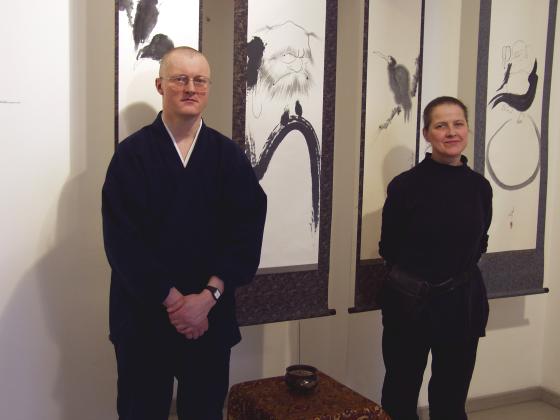
| Nyogen Nowak & Ewa Hadydon |
| Nyogen Nowak & Ewa Hadydon e-mail: zendustart@gmail.com | |
I first encountered Nyogen-san’s art on a fan that was given to me by my friend and abbot of Taiyoji, Zenko-san. This fan had a beautiful image of Bodhidharma in conversation - or in some kind of wordless rapport - with a small black bird. The joyful spirit of this ink painting was very striking, and it was surprising to learn that it had been created by a Polish Soto Zen monk living with his artist wife in Sendai.
It wasn’t until this year that I was able to see a body of work by Nyogen-san, and also one by his wife, Myoshin-san, in an exhibition in the beautiful Daisho-in Temple in Miyajima, Hiroshima Prefecture. In this collection of pieces, I was really able to see the joy, humor, and lightness of spirit that characterise the zenga tradition. At the same time, Nyogen-san’s paintings expressed a simplicity and depth that was clearly arising from his life-long practice of meditation and sesshin at Bukkokuji, in Fukui, mostly under the direction of the late Harada Tangen Roshi.
A centre-piece of this exhibition was an Enso inspired by Tangen Roshi - for whom the creation of enso was both a practice expressing his deep realization, and a way of giving to his students and temple community. The prime placement of this enso reflects the centrality of this teacher’s influence on Nyogen-san, his life and work. On either side of this striking enso were works of great depth and humor, all without a single unnecessary brush stroke.
Tangen Harada Roshi would often use the image of a mountain that never changes as a way to express the true nature of all human beings, and the Mount Fuji of this exhibition had the same quality of timelessness, presence and oneness. One explanatory note quoted the poem on Mt Fuji composed by the famous sword master, calligrapher and zen practitioner Yamaoka Tesshu (1836-1888):
Magnificent in the sun,
Magnificent in the clouds,
Fuji
Original form
Never changes
All the exhibited paintings had this same quality of tapping into a timeless essence or origin, in terms of form as well as content. Without knowing Nyogen-san, it would have been very difficult to know when in zen history these paintings had been created - it could have been 400 years ago. At the same time, there was a distinct humor and interplay of elements that seemed to arise specifically from Nyogen-san and his deep commitment to zen training.
Explaining his work to me and the international group of monks and nuns that had accompanied me to Daisho-in, Nyogen-san said his art is a ‘side-effect’ of his Zen practice, and Myoshin-san, Nyogen-san’s wife, referred to both of their work as a ‘by-product’. It is hard to imagine such an accomplished body of art being simply a side-effect or by-product, but it is also clear to see that the wholehearted engagement with zen is indeed what has enabled both these extraordinary artists to create what they do - works of both immense skill and effortlessness.
It was a great blessing to attend this exhibition, and the monks and nuns along with me - from all over the world - were deeply touched and moved by the quality and depth of Nyogen-san’s work.There was likewise a great appreciation for Myoshin-san’s exquisitely crafted mikkyoga or esoteric works.
Last but certainly not least, I must mention the deliciously home-baked Polish apple cake we were greeted with.
May their work flourish and continue to inspire and illuminate all who have the good fortune to see it.
Suzuki Seido Docho, Abbot, Toshoji-Shuritsu Senmon Sodo, Okayama,
December 30th 2022
Daibai-ji, the temple of which I am the abbot, is located on Banzan Hill just to the west of Sendai Castle. It was built in 1650 by the Date family, the feudal lords of Sendai as a training temple of the Rinzai school of Zen.
In March 1993 during the first breeze of the coming spring, Nyogen-osho(*) and Ewa-daishi(**) climbed the stone steps of Daibai-ji and appeared at our zazen meeting. That was the first time that I met them. Both of them were painters. Nyogen was doing Zen paintings (zenga) and Ewa was doing esoteric paintings (mitsuga). Both of them had reached high levels in their art.
It has been said that "Zen is natural, simple, assymmetrical, free from wordliness, calm, austerly sublime, and subtly profound." But this is the impression of an outsider. If a Zen person wants to be self consciously aware of this essence, he or she is an imposter. One must have these qualities without being consciously aware of them.
In Zen, explanations or speeches are not necessary. You can experience the essence through zazen. The same can be said of zenga. Extraneous brush strokes are not only annoing, but also not in keeping with the essence of Zen. Zenga should be drawn from the Zen spirit.
Recently, Nyogen's brush work has been gettings sharper. His depictions, made with rapid brush strokes, of small animals as if frozen in time attracts me very much. I truly believe that he has a future as a Zen artist. If he continues to devote himself do Zen practice and painting, he will certain establish his name in zenga.
In Ewa's works, faces of Buddhas and Sanskrit letters (bonji) pervade each other in an infinite and mysterious world, reflecting in that way the perfect state of the Buddha's mind. She depicts each Buddha in detail, imbuing the drawing with her spirit and making the most of the fine characteristic of ink and bonji. As I stand in front of her works, I feel naturally inclined to join my palms together in reverence because of subtly profound atmosphere of esoteric Buddhism that emanates from her paintings.
At first sight the painting styles of Nyogen and Ewa seem to reflect two very different outlooks. In the Buddha's mind, however, they fuse into oneness.
I hope from the bottom of my heart that they will continue to devote themselves to zazen and to their art works in a fruitful manner.
Hoshi Yuun
The 26th Abbot of Daibai-ji Temple
Former Curator of the Sendai Historical Museum
30 October 1997, Daibai-ji, Sendai
___________
(*) osho sk. upadhyaya. Originally the title of a precept-master. In Zen tradition, one of the ranks of a Zen priest.
(**) daishi. In Zen tradition, a title used to refer to a lay woman who has received the Buddhist precepts.
Around five, maybe six, years ago I had a chance to meet Nyogen Nowak, a Polish zen monk. He came to see materials concerning Miyamoto Musashi. Although he didn't wear robes at that time, his head was shaven and his behaviour was impeccable. He had a poignant but calm look and it was easy to feel that he treat his practice seriously, which is quite unusual among monks in Japan these days. He made a great impression on me. We talked about the unique spirit one can feel during the intercourse with suibokuga - monochrome ink paintings left by Musashi. Together with Nyogen who is perfectly knows the ins and outs of the art of zen (me being a complete amateur) we also discussed, as far as I remember, Musashi's fighting style, about which he wrote in his works. Nyōgen said that in the near future he intends to publish a book in Poland entitled: Miyamoto Musashi - Master Of Sword And Brush (working title). Some time after our meeting Nyogen sent me a table of contents together with an outline of the book as well as Obaku bunka (No. 124), the magazine where he published his article: The Encounter Of Buddhism And The Art Of Zen. Reading this essay helped me learn more about the author and his works. Nyogen Nowak was born in 1956 in Wroclaw, Poland. When he was fifteen he got from his mother a gift - a book about Buddhism. That is how his adventure with this religion and Buddhist art began. Three years later he sat in zazen for the first time. In 1980 he moved to the United States, where he was ordained as a zen monk in one of the local zen centers. Shortly after that, he had a chance to come into contact with the art of zen for the first time. In 1983 he came to Japan with the intention of deepening his practice of zen. From that time until now he has been practicing as a student of Harada Tangen Rōshi, the abbot of Bukkokuji, the monastery in Fukui prefecture. In 1986 he was ordained again, this time in Japan, and a year later he received Dharma transmission thus becoming a fully qualified zen priest. Since 1989 he has lived in Sendai with his wife Ewa Myōshin Hadydon practicing zazen and zenga painting. From time to time both organize their exhibitions in Japan and Poland as well. When Nyogen was young he used to create oil paintings in a surrealistic style but when he seriously began to turn to zen he was afraid that it may eventually become an obstacle in his practice. If we look at art as a way of expressing oneself is it not the case that in Nyogen's art of zen once abandoned disturbing emotions (desire to express oneself through the medium of art) come alive again penetrating the interior of the artist, changing his form and character? I am very interested in this drama of transformation. In his article Nyogen writes about the relationship between zen and the art of self-expression quoting the part of Yokoyama Setsudō's speech: "We shouldn't differentiate between zazen, calligraphy and daily walking, standing, sitting or lying down." The author speaks also about the so-called great silence - the unity of motion and stillness, and the so-called “spirit of the ink”, which has the potential of life energy gushing from the line led by the brush. His interest and appreciation for Musashi comes perhaps from Niten's (Musashi's Buddhist name) in Fight Spirit: "Moon in the cold stream of the river, clear like a mirror." Last autumn I went to Sendai to visit Nyogen and Myōshin to discuss the details of the oncoming exhibition. Both artists live Shingetsuan, modest cottage with a crooked roof and barely sliding shōji (Japanese paper sliding doors). This is where they live, practice and create their art. I had the opportunity to see the work of both artists and taste vegetarian meals prepared especially for the occasion by Myōshin. It was easy to sense this meaning of Nyogen's words when he spoke of constant practice, regardless of whether you're walking, standing, sitting or lying down. It was for me a very joyful and exciting experience.
Shimada Shinsuke
The curator of Shimada Museum, Kumamoto
Kumamoto, April 4, 2009, "Kumamoto Nichi Nichi Shinbun"
translated by Hojun Szpunar
Basho
In March of 1998, Museum of Japanese Art and Technology, Manggha in Krakow, Poland, displayed Nyogen Nowak and Ewa Hadydon's works called "Zen Dust".
Nyogen showed his scrolls of zenga and Ewa- secret, esoteric faces of Buddhas. Both came to Krakow from far Sendai (Japan) to share their art with us, which- we had chance to acknowledge- in their lives means much more than just artistic creativity, made only for benefit of money or pleasure by typical contemporary artists.
For Polish public this exhibit was mostly a meeting with Buddhist art. Our gallery, filled with music, bell sounds, monk chants and delicate smell of incense, became, for a time of exhibit, a place of meditation and concentration.
Chora
Zen Dust was also a meeting with people which is also important. Nyogen and Ewa, who were always happy and smiling, brought brought peace and kindness to our Museum. It does not happen too often to see so much of agreement and creativity of artists, as you could see in Nyogen and Ewa. The results are probably from a certain way of life that they lead, from experience of Zen Buddhist, whom they live everyday.
Issa
Meeting with "Zen Dust" and their authors persuades to more general thinking. West was fascinated with East years back, with its culture, philosophy, and their way of thinking. It seems that our generation is more interested into now, then it was years back and interest is still growing. It is not only an indication of superficial, temporary fashion, but also a consistent pursuit to understand, sometimes very far away from European tradition. Right now though, we can feel a doubt, whether mastering and understanding, and then- taking over a new tradition, is even possible. A good example are Nyogen Nowak and Ewa Hadydon- people, who coming from Poland to Japan, came a long way "from West to East" - show how you can be consistent in this matter.
George Swede
Nyogen Nowak mastered expression of paintbrush and ink to perfection. His painting style, strong, but in the same time very subtle, precise, faithful to old tradition, but by using a chance, he proves that we can jump over barrier of culture, only if a person is persistent to the determined point, and everything this person does, he does it with a part of him or her self.
Basho
It is even harder to understand how Ewa Hadydon paints mysterious, threatening and beautiful Buddha's faces, different in each incarnation, filling the background with ancient magic signs of Sanscrit. The artist is surrounded with reality, that for us it seams inaccessible.
Ryota
The exhibition of Nyogen Nowak and Ewa Hadydon's in "Manggha" Museum drew attention not only from people connected with Zen in Poland, but also people who were interested in Japanese culture and those are more in Krakow everyday. A huge sensation was made on Japanese people, whom are gathered around the Museum. A lot of people remembered the special mood of silence, which accompanied this exhibition. We are thankful to Nyogen and Ewa, that they wanted to share with us their Zen Dust.
Krakow, January 29-th, 1999
See also:
Pictures:
Movies:
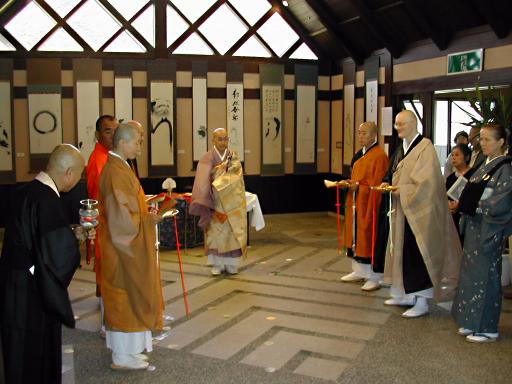
| "Zen Dust" Exhibition in City Gallery in Wroclaw (2018) - works | "Zen Dust" Exhibition in City Gallery in Wroclaw (2018) - opening of the exhibition |
Begining bell
Chanting of Prajna Paramita (Hannya Shingo) Sutra
Zen painting demonstration - zen circle (enso)
Zen painting demonstration - (Bodhidharma)
Chanting of transferring the merit (eko)